Sonic Frontiers Was the Wake-Up Call Sega Needed — And It Finally Listened
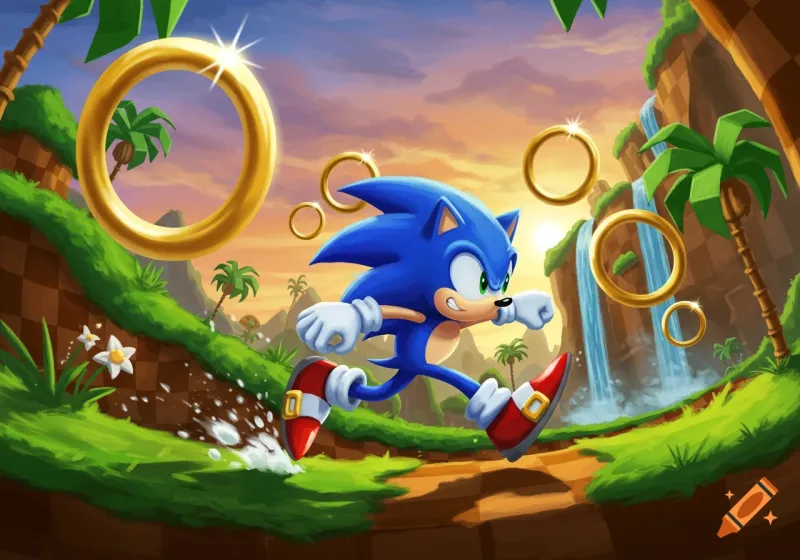
Photo: blue hedgehog video game character running through open green landscape, via media.craiyon.com
Let's be honest with ourselves for a minute. If you've been a Sonic fan in America for any meaningful stretch of the last 20 years, you've spent a lot of that time apologizing. Defending. Hedging. "The music's good, at least." "The 2D sections are fine." We've all been there, standing in a GameStop checkout line with a new Sonic game and a quiet, gnawing sense of dread.
Then Sonic Frontiers happened, and something shifted. Not just in the reviews — though the response was warmer than anything the series had seen in ages — but in what the game actually is. For the first time since the Dreamcast era, a 3D Sonic game feels like it knows what it wants to be.
The Long Identity Crisis
To understand why Frontiers matters, you have to understand the mess that came before it.
Sonic Adventure 2, for all its jank, had an identity: momentum-based platforming split between hero and villain campaigns. It was ambitious, sometimes clumsily so, but it was a direction. Then the Dreamcast died, and the franchise entered what historians will kindly call "the wilderness years."
Heroes leaned into team mechanics. Shadow gave us guns, because 2005 demanded it. Sonic '06 shipped broken and became a cautionary tale taught in game design courses. Colors found charm in a smaller package. Generations is genuinely beloved — and to be fair, it's the closest thing to a consistent formula the series had. But even Generations was more of a greatest-hits victory lap than a new blueprint.
Then came the era of reaction: Sonic Boom's disastrous launch, the movie doing the unthinkable and actually working, Mania reminding everyone what classic Sonic felt like — and Forces, which promised a return to form and delivered something that felt like a tech demo with a soundtrack far better than it deserved.
Every one of those games asked the same question — what is 3D Sonic supposed to be? — and every one answered it differently. That's the crisis. Not bad games, necessarily. No point of view.
What Frontiers Actually Got Right
Frontiers didn't reinvent the wheel. It did something smarter: it gave Sonic room to be fast without constantly fighting the level design.
The open-zone structure — not quite open world, more like a series of sprawling islands — lets you chain together loops, rails, and platforms at full speed, then pull up short for combat, puzzles, or platforming challenges at your own pace. Previous 3D Sonic games solved the speed problem by putting you on rails. Frontiers handed you the wheel and trusted you not to crash.
The combat, borrowing liberally from character action games, gave Sonic actual mechanical teeth. Cyberspace stages gave the classic-boost fans their fix. And the story — tonally strange, genuinely melancholic, with Sonic slowly helping a digital girl remember who she is — took emotional risks the franchise hadn't touched since the Adventure days.
Was it perfect? No. The poppin' cycle of tower puzzles got old, and the draw distance could charitably be called "mysterious." But it was a thesis statement, and that's more than the series had offered in two decades.
The Numbers Don't Lie, And Neither Do the Fans
Frontiers sold. It became one of the best-selling 3D Sonic games ever, and critically, it landed well enough that even longtime skeptics wrote pieces with titles like the one you're reading now. More importantly, Sega treated it as validation, not a fluke.
The roadmap that followed — major content updates, a movie sequel building on the goodwill, and heavy hints that the next mainline entry builds directly on the open-zone formula — tells you everything. Sonic Team isn't hitting reset again. That alone makes Frontiers the most important Sonic game in 20 years, regardless of how you personally scored it.
Where the Blue Blur Goes From Here
The real test comes next. Frontiers was a foundation, and foundations aren't glamorous. The next game needs to refine the zones, expand the combat, and — please — give us more variety in the puzzle design. If Sonic Team iterates the way Nintendo iterated from Breath of the Wild to Tears of the Kingdom, we could be looking at the start of something genuinely special.
For those of us who never left, who bought every misstep at full price and defended '06 on message boards with our whole chests, Frontiers felt like being seen. Not perfect. Not finished. But finally, unmistakably, pointed in the right direction.
The hedgehog's been running in circles since 2001. Frontiers is the first game that let him actually go somewhere.