Before Your Friends List: How SegaNet Saw the Future and Blew the Money Anyway

Photo: Evan-Amos, Public domain, via Wikimedia Commons
There's a specific sound that defines the Dreamcast era for a certain kind of American kid: the screech and warble of a 56k modem dialing into SegaNet while somebody else in the house picked up the kitchen phone and killed your match. It was fragile, it was expensive, and it was absolutely the blueprint for everything you do on a console today.
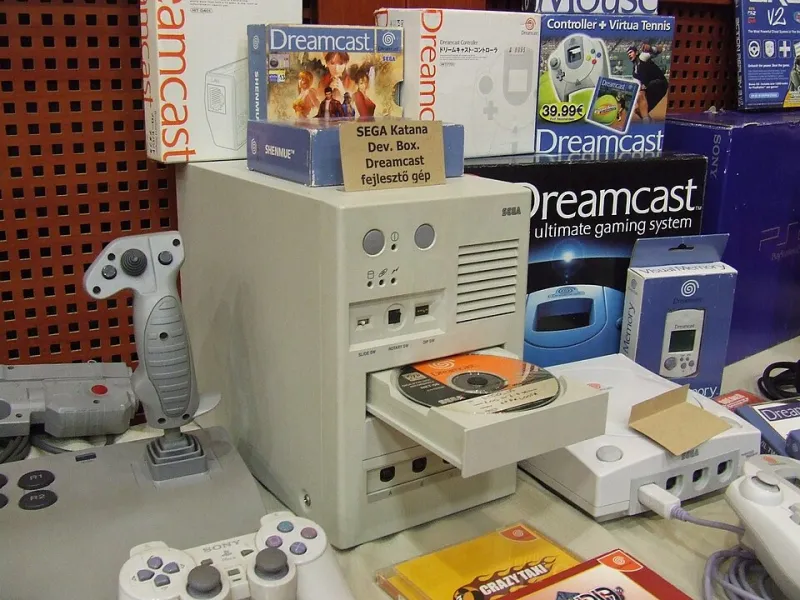
Sega launched the Dreamcast in September 1999 with a built-in modem. Not an add-on. Not a peripheral you'd buy later at Funcoland. The thing shipped online-ready, and by the summer of 2000, Sega had rolled out SegaNet — a dial-up gaming network with its own subscription fee, roughly $10 a month after the initial rebate-fueled freebies ran out. In an era when most people still thought of consoles as couch toys, Sega was asking a question nobody else in the industry had the guts to ask: what if the machine in your living room was a node on the internet?
The Rebate Economy of Early Online Gaming
Sega knew nobody would pay for console online play sight unseen, so they ran promotions that were, frankly, unhinged in hindsight. Sign up for two years of SegaNet and you'd get the Dreamcast itself plus the modem rebate — effectively a free console, subsidized by a dial-up subscription in a country that was already flirting with broadband. It was the same playbook cell carriers used with free phones and two-year contracts. It worked well enough to build a real network, and not well enough to ever turn a profit.
And here's the thing people forget: it actually functioned. Quake III Arena ran online on the Dreamcast before any other console could claim that. NFL 2K1 shipped with full online league play. This wasn't a tech demo — it was competitive, functional, live online gaming on a television, years before anyone else managed it.
Phantasy Star Online Was the Whole Thesis in One Game
Then came Phantasy Star Online in late 2000, and the argument stopped being theoretical. PSO wasn't a port of a PC game or a shooter with a networking mode bolted on. It was an RPG — the genre most associated with long solo campaigns — rebuilt from the ground up around playing with strangers. You picked a server, joined a lobby, teamed up with three random people whose names you'd never know, and hunted through dungeons together.
If that sounds like literally every live-service game on the market right now, that's because it is. The lobby-and-instanced-mission structure, the loot loop, the guilds-with-different-names — Sonic Team drew the modern template in one game. When you and your Discord friends queue into a raid tonight, you're running a playbook PSO wrote before the Xbox even existed.
The Browser Nobody Asked For and the Future Nobody Noticed
SegaNet wasn't just games, either. The Dreamcast got a full web browser — first Planetweb, later versions with better rendering — and a disc that turned your console into a dial-up internet terminal. People checked email on their Dreamcasts. People browsed the early web on their Dreamcasts. It was slow, it was awkward, and it was a preview of a convergence every console maker would eventually chase: the game machine as the household's all-purpose connected device.
The Dreamcast even dabbled in digital distribution through downloadable content and network features in Japan. The pieces were all there — storefront, network, community, persistent identity. Sega just couldn't make the economics close before the company pulled the plug on the hardware in 2001.
Why It Died and Why That Matters
The postmortem is brutal and simple: Sega was a hardware company bleeding cash, broadband was eating dial-up's lunch, and $10 a month for a wobbly online experience was a hard sell in a country where Xbox Live would soon offer a slicker version for $50 a year. SegaNet shut down in 2003. The Dreamcast's servers went dark. The narrative wrote itself: Sega was too early, too broke, too ambitious.
But "too early" is doing a lot of work in that sentence. Every major element of Sega's online dream eventually became the industry standard. Subscription-based online play? Xbox Live and PS Plus. Console web browsing and apps? Every current machine. Console digital storefronts? Standard. Community-driven multiplayer with persistent characters and lobbies? The entire modern live-service economy. Even the rebate-subsidized hardware model survives, quietly, in how console makers sell hardware at a loss and make it back on services.
The difference is that Sega tried to build the whole ecosystem on 56k modems with the resources of a company already losing the console war. Microsoft got to run the same experiment with near-unlimited capital and a broadband country ready to receive it.
Playing It Today
The beautiful twist in this story is that SegaNet never really died — the fans kept it on life support. Private servers for Phantasy Star Online have run for two decades, letting players experience the original online magic long after Sega's own infrastructure went dark. Modern re-releases and community patches have made the Dreamcast's online legacy more accessible in 2025 than it was in 2005. If you've never felt a PSO lobby fill up with strangers, that door is still open.
Sega's online gamble is usually remembered as a noble failure — one more item on the Dreamcast's tragic rap sheet. That framing undersells it. SegaNet didn't fail because the idea was wrong. It failed because the idea was right and the moment wasn't. The rest of the industry spent the next twenty years proving Sega correct, one subscription at a time.
Every time your console boots straight to an online dashboard, every time a game ships with a season pass and a friends list and a lobby, you're looking at the future Sega drew up in 2000. They just didn't live to collect on it.