Five Weekends, One Save File: How Blockbuster Taught America to Love Sega
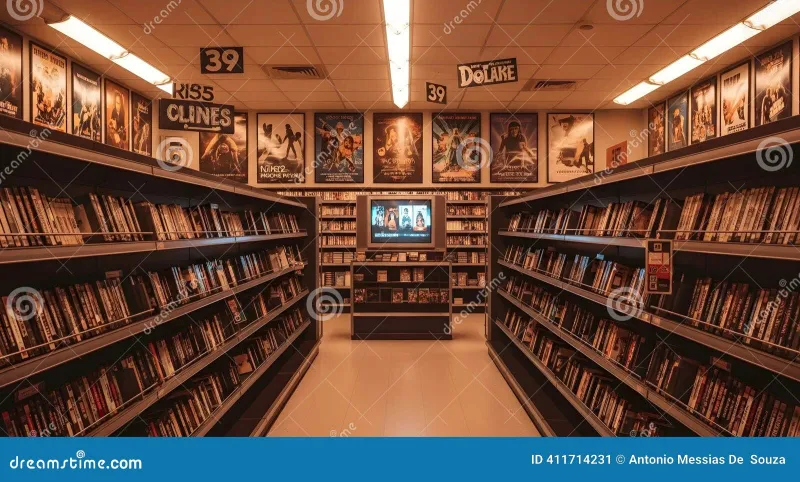
Photo: 1990s video rental store VHS shelves nostalgic interior, via thumbs.dreamstime.com
Nobody in my neighborhood owned Phantasy Star IV. Everybody in my neighborhood had played Phantasy Star IV. That paradox made perfect sense in 1995, because the game didn't come from a store shelf — it came from the rental case at the local video store, passed hand to hand like a sacred text nobody was allowed to keep.
If you grew up in the US during the Genesis era, there's a decent chance your first Sega memory isn't unboxing a new game. It's the smell of a video rental store. The beeping barcode scanner. The wall of plastic clamshells, each one a lottery ticket. And somewhere in that wall, a Sega game you'd rent for the fifth consecutive weekend because there was no way a ten-year-old was beating Comix Zone in three days.
The Economics of Not Owning Anything
New Genesis cartridges ran $50 to $70 in early '90s money — a genuinely insane ask for a kid whose entire income was a weekly allowance and whatever change fell out of dad's pockets. Renting cost three bucks and came with a built-in deadline.
That deadline was the whole magic trick. Rental games weren't experienced; they were conquered. You had roughly 48 hours, and every minute of Saturday morning cartoons you skipped was a strategic decision. Games got beaten under pressure in a way that's almost impossible to recreate now, when every game sits patiently in a digital library waiting forever.
Parents loved it too. Why drop sixty dollars on a game the kid might hate when the rental store offered a risk-free trial? This is why so many Genesis collections were weird and lopsided — one or two owned classics surrounded by a rotation of rented oddities nobody would ever buy.
The Photocopy Underground
Here's a detail only rental kids will remember: half the time, the game came with no manual at all. Some previous renter had swiped it, or the store kept manuals behind the counter, or the manual had simply disintegrated from use.
So we improvised. Kids photocopying game manuals at the library is one of the great unsung folk traditions of the era. A folded, slightly crooked copy of the Shining Force II control page was currency. Somebody's hand-drawn map of the Landstalker dungeons, done in ballpoint pen on notebook paper, was worth more than the game itself to the next renter.
Video stores accidentally became knowledge-sharing hubs. Tips scribbled on index cards. The one kid in town who knew the water level code for Sonic the Hedgehog, dispensing wisdom like an oracle. We were crowdsourcing walkthroughs a decade before GameFAQs, and the library copier was our infrastructure.
The Save File Handoff
Console games saved to the cartridge itself, which created a beautiful problem: your progress stayed with the rental. Beat three hours of Beyond Oasis on Friday night? That save rode back to the store on Sunday, where some stranger's kid might pick up exactly where you left off.
It was accidental cooperative play across time. You'd rent a game and find someone else's save already deep into the campaign — a mystery file, a head start, a gift from a stranger. Sometimes you erased it without ceremony. Sometimes you felt weirdly obligated to protect it and build on their work. Either way, every cartridge carried ghosts.
The Rental Classics
Some games were bought by almost nobody and played by almost everybody, purely on the strength of the rental circuit. The unofficial hall of fame:
- Comix Zone — Gorgeous, brutal, and about ninety minutes long. The perfect rental: you'd never pay full price for it, but you'd rent it three times trying to get past the first two pages.
- Vectorman — A pre-rendered light show that looked unbelievable on a store demo reel. Rented constantly, owned rarely.
- Shining Force II — A 40-hour strategy RPG squeezed into 48-hour rental windows. Nobody beat this in one weekend; it took a neighborhood rotation.
- Rocket Knight Adventures — The kind of game you'd grab on impulse because the box art ruled, then rent again the next weekend because it ruled harder than expected.
- Ecco the Dolphin — Atmospheric, alien, and deeply confusing without a manual. Which, of course, was missing.
- Kid Chameleon — Impossibly long, brutally hard, and the archetypal 'rented five weekends in a row' game.
What We Actually Lost
There's a version of this nostalgia that's just 'things were better before,' and that's not quite it. Waiting a week to maybe rent a game you wanted was its own kind of misery. Modern access is, on the whole, wonderful.
But something specific evaporated: scarcity with a clock on it. Rental games demanded your full attention because your time with them was finite and visible. Finishing Beyond Oasis over a summer of weekend rentals meant something — it was a small project, a negotiation with time, a shared object moving through your whole town.
These days I own every Sega game ever made, more or less, and I finish almost none of them. The Genesis Mini sits on a shelf, patient and infinite, asking nothing of me. Maybe that's the real lesson of the rental era: we didn't love those games despite the deadline. We loved them a little bit because of it.
Now if you'll excuse me, I need to go track down a complete-in-box copy of Comix Zone. Some debts take thirty years to settle.