Say It: The Four Seconds of Sound That Raised a Generation
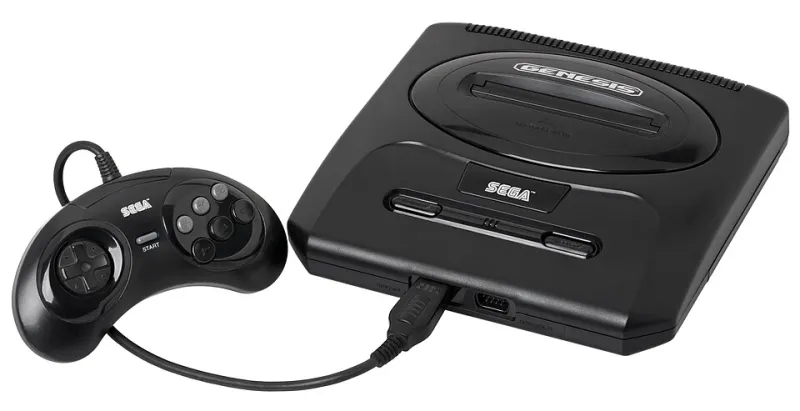
Photo: Evan-Amos, CC BY-SA 3.0, via Wikimedia Commons
Four seconds. That's all it took. A low synthesizer voice, a rising chant, and then that word — SE-GA — stretched across two syllables like a door swinging open into another world. If you grew up in America in the early '90s, you don't remember hearing it for the first time. You just remember it being there, the way you remember the smell of a new cartridge or the weight of a Genesis controller in your hands.
This is a story about four seconds of audio that did more marketing work than a hundred million-dollar ad campaign — and somehow never wore out its welcome.
A Choir of One
The chant we know and love wasn't some corporate jingle cooked up in a Madison Avenue boardroom. It traces back to 1988, when Sega of Japan was preparing to launch the Mega Drive and needed a sonic logo to match its arcade swagger. The version most Americans know — the fuller, more dramatic arrangement that played on the Genesis — was built around a synthesized vocal patch, with the melody climbing a simple scale before landing hard on that final, triumphant "SE-GA!"
What made it work wasn't complexity. It was confidence. Nintendo's startup on the NES was a polite little gong. The Sega boot screen was a battle cry. It didn't ask if you wanted to play — it announced that play had already begun.
There's a reason the phrase "Blast Processing" worked as marketing, and it's the same reason the chant worked: Sega in that era understood that perception is the product. The sound was cool before the game proved anything. By the time Sonic hit the screen, you'd already been told how to feel.
Your Brain on Sega
Talk to anyone who grew up with a Genesis and they'll describe the same reflex: hear the chant, feel the dopamine. Psychologists call this conditioned response — the same mechanism that makes your stomach growl at a lunch bell. Sega accidentally ran one of the largest Pavlovian experiments in American history, with millions of kids as the test subjects.
The genius is in the structure. The chant rises. It builds tension across those first few notes, holds it, and then releases on the final syllable — a tiny musical punchline. Every single time. Game designers spend careers trying to build reward loops that satisfying. Sega put one before the game even started.
And unlike a lot of era-specific audio, it never got annoying. Part of that is brevity — four seconds is a blink. Part of it is that the chant carried no gameplay baggage. It wasn't tied to a level or a character. It was tied to the idea of Sega, which meant every boot-up reinforced the brand rather than wearing it down.
The Afterlife of a Chant
Here's where it gets fun: the sound refused to die. Sega retired the hardware business in 2001, but the chant kept showing up like a relative who won't leave the party.
- Sonic movies use it as a punchline and a wink — the 2020 film's marketing knew exactly what a shot of the logo would do to the parents in the theater.
- Modern games sample it constantly. Anything Sega publishes with a hint of self-awareness finds a way to echo those rising notes.
- Internet culture turned it into a meme format all its own — remix it, orchestral it, blast it over chaos videos. The chant became a universal shorthand for "here we go."
- Other studios have chased it. Listen to modern sound logos — the rising-falling shape, the vocal texture, the confidence — and you can hear designers openly reaching for the same magic. Almost none of them catch it.
Why doesn't it work for anyone else? Because the chant wasn't really about the notes. It was about the moment. It marked the threshold between your homework and your hedgehog, between the real world and the one on the TV. You can copy a melody. You can't copy a childhood.
Four Seconds, Forever
There's a lesson buried in this for anyone who makes things: the most durable branding rarely announces itself as branding. Sega wasn't trying to create a generational totem. They were trying to sound cooler than Nintendo. The totem was a side effect.
Plenty of us have replaced our Genesis with emulation, mini consoles, or a dusty original hooked up through a sketchy RF adapter. But every time that chant kicks in — through a CRT, a flat screen, a phone speaker — the same thing happens. Shoulders drop. Grin appears. Somewhere in your brain, a kid is grabbing a controller.
Four seconds. One word. Still undefeated.