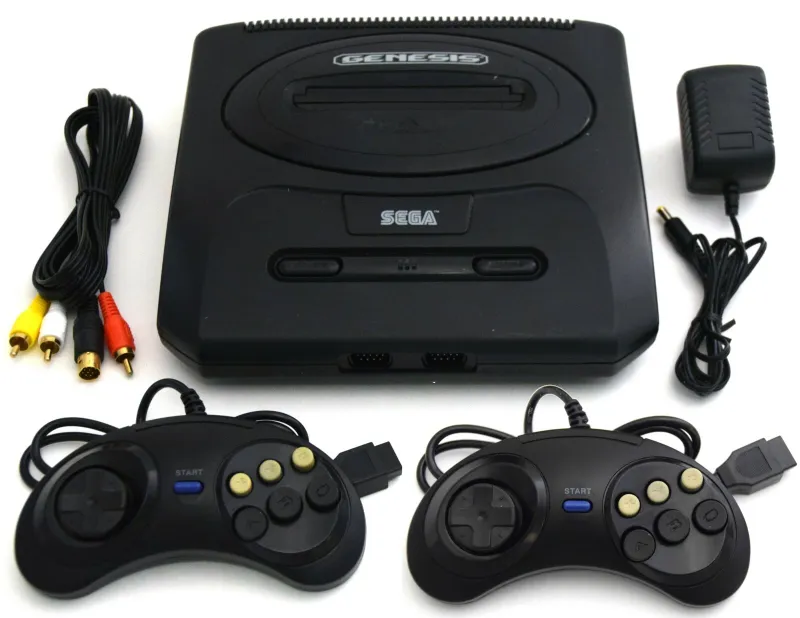
The Unwritten Constitution of the Sega Sleepover: Rules Every '90s Kid Followed Without Knowing Why
Nobody handed you a rulebook when you showed up to a sleepover with your Genesis in a grocery sack and a duffel bag full of cartridges. And yet, every kid in every basement across America in 1994 seemed to know the exact same set of laws. Don't pause the game without asking. Don't pick Tails if the Sonic player hasn't OK'd it. Loser hands over the controller. Winner keeps playing. These weren't written anywhere. They didn't need to be.
Looking back now, it's clear we weren't just playing games. We were running a small, self-governing society with a legal system built entirely on grudges, honor, and whoever's mom brought up the pizza rolls.
The Sacred Rite of Controller Rotation
The pass-the-controller system was the backbone of 16-bit multiplayer, and it was brutally efficient. Streets of Rage II with three friends and one game meant a strict rotation: you died, you handed it off, you waited. There was no rage-quitting because there was no such thing as quitting — you simply existed on the couch, watching, waiting for your turn like it was a license renewal at the DMV.
And here's the thing: that waiting was the point. Some of the best conversations of my childhood happened during someone else's run through E-Honda's bathhouse or the Sunset Riders saloon level. You learned your friends' habits. You learned who got greedy with health pickups. You learned who'd whisper "I got this" right before dying to the same boss four times.
The controller itself had weight — literal and figurative. Handing it over was a small ceremony. Sliding it across carpet was rude. Handing it with the cord untangled was a courtesy that said everything about your character.
Sonic 2: The Original Friendship Stress Test
If Streets of Rage taught cooperation, Sonic the Hedgehog 2 taught betrayal. The co-op mode was nominally about teamwork, but everyone knew the truth: Tails was a hostage, and the Sonic player was his captor.
The famous grudge generator, of course, was the special stage ring. If you were playing Tails and your friend missed a ring entrance at the end of Act 2, you had a legal obligation to be upset about it until at least middle school. I know adults — responsible, mortgage-having adults — who still bring up the Chemical Plant Zone ring their best friend whiffed in 1993. The friendship survived. The grudge was grandfathered in.
There were regional variations, too. In some households, Tails was allowed to catch up via being carried in the screen. In others, Tails simply despawned off-camera for minutes at a time, a ghost in the machine, until the Sonic player deigned to slow down. Neither system was fair. Both were universal.
Cheat Codes Were Our Oral Tradition
Before you could look anything up in three seconds, game knowledge traveled by word of mouth, passed kid to kid like folklore. The Konami Code wasn't from a Konami game most of the time, but that didn't matter — it was scripture. Someone's older cousin told someone at school, who told you at lunch, and if the code worked, that kid gained status. If it didn't work, you were allowed to be mad at them forever.
Level select in Sonic 2 (up, down, left, right, up, up — you know it, don't pretend you don't). The debug mode secrets. The street rumors that were pure fiction, like the one about Aeris coming back or Sheng Long in Street Fighter II. We were all amateur journalists with zero fact-checking infrastructure, and the misinformation rate was spectacular.
That's what I keep coming back to when people ask why we're nostalgic for split-screen and hot-seat multiplayer. It wasn't the games, exactly. It was that the games forced us into the same room and made us negotiate everything — turns, rules, blame, glory — face to face.
The Sleepover Was the Server
Modern online play is a miracle, honestly. Matchmaking, lobbies, crossplay — it's all better technology than a kid yelling "one more race" at 1 a.m. while his friend's mom waits in the driveway with headlights on.
But the old system had features the new one never replicated. Latency was zero because your opponent was three feet away on a beanbag chair. Trash talk had consequences because trash talk had a face. And when a match ended, you didn't queue into the next lobby with strangers — you stayed in the room with the same people, and the result of the last game colored the next hour of your life.
Losing stung more. Winning meant more. And the friendship — the actual friendship — was the infrastructure everything ran on. You couldn't block somebody. You had to see them at school Monday.
Maybe that's why the grudges lasted. They weren't just about a missed ring or a stolen continue. They were proof you were there, in the room, when it mattered. The Genesis is long since unplugged, but the constitution those sleepovers wrote is still rattling around in our heads, one unwritten rule at a time.