The Upgrade Treadmill Started in 1992: Reconsidering Sega's Add-On Era
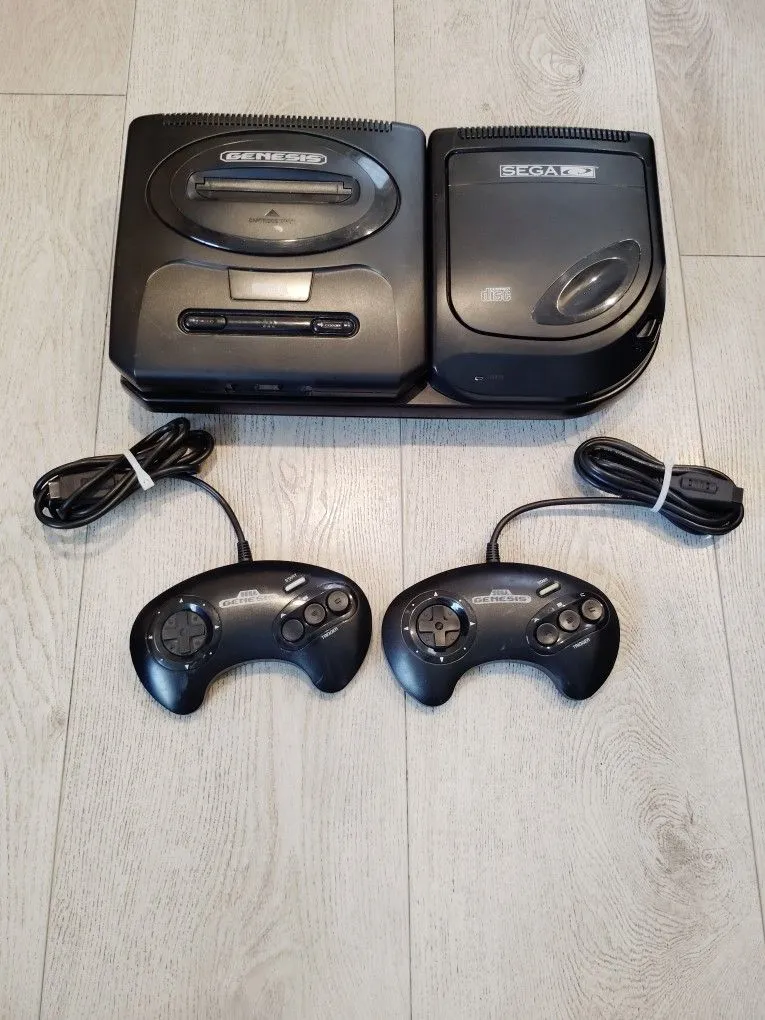
Photo: vintage Sega Genesis console with Sega CD add-on 1990s, via images.offerup.com
There's a moment every Sega kid from the early '90s remembers: flipping through the pages of EGM or GamePro, seeing an ad for the Sega CD, and feeling your stomach drop. Not because it looked bad. Because you'd just spent two summers mowing lawns to buy the Genesis, and now Sega was telling you it wasn't enough.
We didn't have the vocabulary for it then, but we were living through the first draft of something that would eventually consume the entire industry. Call it the upgrade treadmill. And Sega built the original model.
The Add-On That Started It All
The Sega CD launched in North America in late 1992 at $299 — roughly the price of an entire Genesis at the time. Sega's pitch was seductive: full-motion video, CD-quality audio, bigger games. The future, apparently, came on a compact disc.
What we actually got was a lot of grainy FMV titles like Night Trap and Sewer Shark, plus a handful of genuine gems — Sonic CD chief among them — that hinted at what the hardware could have been. The promise outpaced the product, but the sales pitch worked. Sega proved people would buy a peripheral that made their existing console feel obsolete.
That's the part that matters. Not the games. The transaction.
Then It Got Worse: Enter the 32X
If the Sega CD was a bold experiment, the 32X was Sega doubling down mid-collapse. Released in November 1994 for $159, it was a beefy attachment that bolted onto the Genesis and promised 32-bit power — right as the Saturn was about to launch at a similar price.
Think about that for a second. Sega asked American families to buy an enhancement for a console they were already planning to replace within a year. Retailers were furious. Parents were furious. The 32X sold a fraction of its projected numbers and left warehouses full of unsold inventory that Sega eventually dumped at clearance prices.
It's easy to laugh about it now — the 32X is a punchline in every retro documentary ever made. But strip away the hindsight and look at the structure of the deal: buy this add-on now, and your games will look better. Doesn't that sound familiar?
The Treadmill Never Stopped, It Just Got Rebranded
Fast-forward thirty years and the add-on era didn't die — it got absorbed into the mainstream. The PS4 Pro and Xbox One X were mid-generation refreshes sold on the same logic: your base hardware is now insufficient. The Xbox Series X and S exist as a two-tier ecosystem. Expansion cards, storage upgrades, GPU bumps — the modern console is less a single device and more a subscription to the idea of staying current.
Digital gaming has layered even more churn on top. Games ship incomplete and get finished through patches and DLC. Your library lives on a storefront that can deprecate your hardware. Even the games are now add-ons for other games.
Sega was never reckless in a vacuum. They were doing what the whole industry does now — fragmenting the platform and asking the consumer to keep pace — just earlier, and with less polish.
Reckless or Ahead of the Curve?
Here's the uncomfortable question this retrospective keeps circling: was Sega wrong, or just early?
The 32X was a genuine failure, no argument there. Bad timing, confusing messaging, and a price point that insulted everyone involved. But the Sega CD? It sold well enough, spawned some legitimately great software, and proved a market appetite for enhanced hardware that Sony and Microsoft would later exploit far more successfully.
The difference is that Sega did it in an era when a console was supposed to be a complete product. They broke the unspoken contract. Today, that contract doesn't exist. Nobody expects their console to be the last one they buy, and nobody expects a game to be finished on disc one.
In that sense, Sega's add-on era wasn't a mistake so much as a prophecy. They showed the industry what was possible when you stop selling a machine and start selling an upgrade path. The rest of gaming just needed a decade to catch up — and the marketing budgets to make it feel normal.
What We Lost Along the Way
There's something a little sad about it, too. The Genesis was a thing — a complete, self-contained object you owned. The Sega CD turned it into a platform in flux. Once you accept that your console can be half-finished, you've accepted the logic that governs gaming today: perpetual incompleteness, forever one purchase away from being whole.
Sega paid the price for being first. The add-on era cratered their hardware business and helped push them out of the console race entirely by 2001. But the lesson they taught — that consumers will tolerate fragmentation if the promise of 'better' is dangled correctly — became the industry's foundational playbook.
So the next time a mid-gen refresh gets announced, or a game launches with a roadmap instead of an ending, spare a thought for that $299 box with the CD tray. Sega didn't just predict the future of gaming hardware.
They sold it to us, one add-on at a time.